Jacobo
Gente que viene y ¡Bah!Jacobo is León’s partner, a Guardia Civil officer, and a recurring presence in the Vélez family’s life. First presented to Bea as the village’s cannabis dealer, he later reveals that he passed the Guardia Civil examinations two years earlier. The contrast between those identities is more than a surprise introduction: his private relationship with León is embedded in a family and community where teasing, loyalty, and public duty repeatedly meet.
Identity and Introduction
Jacobo arrives at Ángela’s birthday gathering carrying a potted orchid wrapped as a present. Bea recognizes him only after taking in how much thinner and more handsome he looks, with his head shaved rather than covered by the long hair she remembers. He greets her as though she should know him, then asks Ángela whether she likes orchids. The gesture, and Ángela’s easy welcome, immediately place him inside a circle of familiarity that Bea has not yet understood.
His habitual use of the tag Oqué has made it a village nickname. It is part of the comic texture of his entrance: he repeats the mannerism even as Bea struggles to work out why her mother knows him so well and why everyone else seems at ease. León greets him with a nod, while Jacobo turns readily to Fin, asking about his motocross racing. Fin is fifteen, has ridden since he was six, and has already won extensively; Jacobo addresses him with the relaxed pride of someone who knows the family’s news and treats the teenager as a champion.
The family describes Jacobo as León’s friend and uses the word fabari for their ambiguous closeness. Bea’s startled understanding of him as her brother’s boyfriend, though not quite a boyfriend, captures a relationship whose intimacy is evident before its status is settled. His place at the birthday table is therefore both ordinary to the family and disorienting to Bea, who has arrived from elsewhere and must catch up with bonds already established in her absence.
León and Jacobo
Jacobo is not simply a friend who turns up at family events: the novel presents him as romantically and sexually involved with León. Their attachment is affectionate, but it is not free of insecurity. When Jacobo comes to the house and goes straight to León, he asks whether León refuses to move in together because a millionaire would consider him beneath his station, or whether León is keeping him around until someone more suitable appears. His questions turn a disagreement about cohabitation into a fear that their difference in wealth and social position makes him disposable.
The scene shows Jacobo trying to name the hurt behind León’s reluctance, but also how quickly uncertainty can harden into an accusation. He imagines himself measured against a richer, more appropriate future partner; León responds by questioning how Jacobo arrived at that conclusion. Their conflict is not presented as a lack of feeling so much as a failure to agree on what commitment should require and when it should happen. The available episodes leave that tension unresolved rather than supplying a definitive account of their future.
Jacobo’s attachment also appears in his admiration for León’s wit. When the family discovers León’s online video work, Jacobo admits that he had not known about it, then responds with pride, insisting that León has always been brilliant. His surprise does not diminish his affection; instead, it reveals that even an intimate partner can discover a previously hidden part of León’s life. The moment gives their relationship a mixture of closeness and incomplete knowledge.
Work, Family, and Practical Help
At the birthday gathering, Jacobo’s identity as a Guardia Civil officer comes as a shock to Bea. Irene explains that he serves in the force, and Jacobo says proudly that he passed the entrance examinations two years earlier. Bea’s astonishment is sharpened by the fact that she has regarded him as the village’s cannabis dealer and asks whether he has left that other life behind. In this exchange, the officer and the figure Bea thought she knew occupy the same social space; the scene foregrounds the contradiction without resolving it for her.
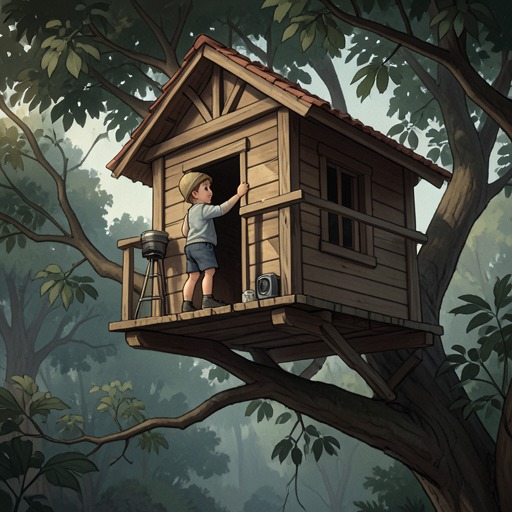
His usefulness to the family becomes concrete when Bea begins building a treehouse. The timber lorry can reach only the nearest forest track, leaving the group with roughly three hundred metres of lumber to carry to the chestnut tree. Jacobo has anticipated the problem and arranged for three fellow Guardia Civil officers to help. Together with León and a sawmill employee who takes pity on the group, they haul the pine boards to the site, where the timber is stacked beside the tree by late morning. The effort is exhausting, but his preparation turns a logistical obstacle into a shared start to the project.
He also offers Bea emotional support after Víctor’s betrayal. Alongside León, Jacobo tries to console her by observing that men can be blinded in the first days of a new relationship; León jokes that infatuation should count as a mitigating circumstance in court. Jacobo’s presence in the exchange matters: despite Bea’s earlier bewilderment about him, he is now among the people who step in to help her. His connection to León has made him part of the family’s practical and emotional network.
Public Duty and Private Cost
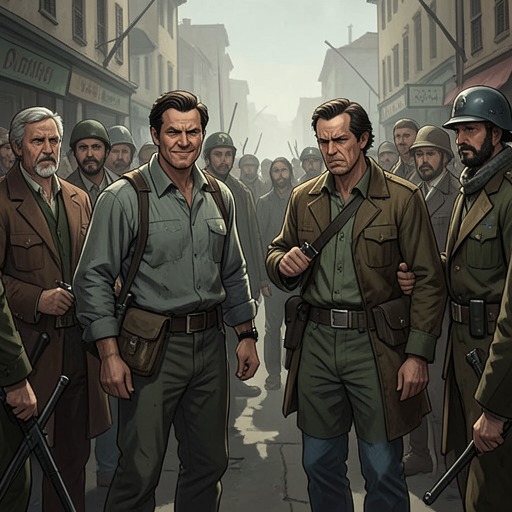
The sharpest collision between Jacobo’s work and his relationship with León comes during the protest against logging in the chestnut grove. As a Guardia Civil officer, Jacobo takes part in removing protesters from the trees and arresting them while the felling resumes. León is among those taken down; Jacobo puts him in handcuffs. From the phone call Bea receives, she hears León accuse Jacobo of arresting his own lover and reject him in anger. Their private bond cannot protect them from the immediate force of Jacobo’s official role.
The arrest gives their earlier ambiguity a harsher public setting. At the birthday gathering, Jacobo’s connection with León is a source of family teasing and comfortable familiarity; at the protest, the same connection intensifies the injury of being treated as a detainee by one’s partner. The scene does not present his duty as emotionally neutral, nor does it erase the consequences for León. Instead, it places intimacy and enforcement in direct conflict, with the handcuffs making that conflict visible.
Character and Narrative Role
Jacobo’s characterization develops through reversals of first impression. Bea initially sees the village figure she associates with cannabis, then learns that he is a trained officer; she is startled by his position in the family, then sees him help carry lumber, support her through heartbreak, and show pride in León. None of these details cancels the others. The story makes his social identity deliberately difficult to reduce to one label, while keeping his actions specific: he brings Ángela an orchid, remembers Fin’s racing, organizes help at the treehouse site, and arrests León during the protest.
His relationship with León likewise moves between easy familiarity, wounded insecurity, shared admiration, and a painful clash with professional duty. Jacobo’s fear that wealth makes him inadequate to León and the later image of him fastening the handcuffs mark opposite pressures on the relationship: private anxieties about belonging, and a public obligation that places the couple on opposing sides. Through Jacobo, the novel shows how a person can be both a member of an intimate family circle and an agent of an institution whose actions fracture that circle.